Thursday, April 28, 2011

Inspiration, Revelation, and Belief


Inspiration, Revelation, and Belief


Hadhrat Mirza Tahir Ahmad (ra)
The Review of Reviews, December 1996


Questioner:
My question is, if a man has led a good life, has been generally helpful to others, but he had no religion, would he have the same reward upon his death as a religious man?

Hadhrat Mirza Tahir Ahmad:
This question is a very important question in the sense that people sometimes are not clear about the term 'goodness' used in general and the term 'religious piety'. These are two different terms. They meet only partially in the sense that all religions must aim at creating goodness in man--but that is not all. All religions promote it with the purpose of enabling man to meet his God, his Creator, when he returns to him. So, if goodness is generated without any reference to God, without any hope of returning to him, then that goodness is sometimes just a hollow shell which does not have the inner kernel and the spirit which must go with it and, hence, it is vulnerable. That is why at times of extreme trials of life it just bursts open and nothing is found from within.

All civilised nations have that 'goodness' about them. All civilised nations which speak of human need and suffering as, for instance, in Africa. There are a large number of people belonging to such nations, who really feel a sense of pain about the suffering (of other nations) and want to share their own sense of happiness with them, to a degree. This is goodness but it is without religion and because it is without religion, in their total thinking as a nation, the collective character of the same people which emerges at the level of international dealings, emerges as a callous character. Many a times they themselves are responsible for the ill treatment of the poor nations because whenever they think of giving them any aid, that aid is always confined to certain political and economic gains, with strings attached, with the result that if you analyse this question in depth, it is impossible to find any advanced nation who helps a third-world country just out of deep, genuine sympathy and natural goodness. In totality their relationships are selfish. It would be a very 'unwise' politician who speaks of the genuine rights of another country and who requires his people to sacrifice in real terms for the sake of a country that is situated in, say, Africa or in some other part of the world.

In international relationships, politics is always selfish and a goodness born out of a belief in God can never be selfish--it is impossible. If you believe in God your goodness has to acquire a universal character. It lifts above the geographic boundaries, colour boundaries, racial boundaries of all sorts--religious boundaries as well and if it cannot lift above the religious domain, and religious differentiation, then it is not a goodness based on a belief in God. That is why it is highly important for you to check yourself occasionally whether your goodness is just out of civilised conduct with which your were born, not a creation of yourself with an effort.
Some people are born good, their temperament is good, they don't want to be violent, they are sympathetic in their attitude. But they are individuals and they are good, regardless, like the fragrant flower which spreads fragrance. But the flower which is fragrant is not rewarded for the fragrance it emits. Reward is something else. Cause and effect, on the other hand, is a different phenomenon altogether. You are talking of an area where goodness is born but not with the conscious effort of sacrifice against your own personal interest. You are talking, perhaps, of a general goodness which is produced or created by a cause different from that of belief in God. Some families have good reputations. There are some families who inherit their 'noble blood' in the sense that the traditions of those families are noble (the blood is the same--there is no question of blood being noble or ignoble). But in that case why should one be rewarded for the noble deeds.

The question would then naturally arise that if someone is born in a society which is habitually vicious, or violent in reactions, which has a bullish tradition, what is the fault of the poor boy who is born in to such a society--why should he be punished? So, when there is no reward (for instinctive goodness), there is also no punishment (for acquired traditions of violence).
These are aspects which belong to the area of cause and effect. Reward and punishment belong to conscious acts which are done with relation to (the belief in) the existence of God and with the realisation that I am held responsible for whatever I do here on earth. In that case you can behave completely contrarily to your social background, to your family background. You may be born anywhere but if your moral behaviour is based on a belief in God then it will rectify you and it is this which is rewarded. Just a general goodness is not rewarded nor are such animals rewarded which have instinctive behaviour either of goodness and kindness to others, (some animals have this instinctive behaviour), nor are those beasts punished for their violence against animals of other species. This is because, again, it is an area of cause and effect where you do not have choices. Choices are essential for reward or punishment and choices can only come into play when you have a divine teaching of "do's and don'ts" where you have the option of following the teaching or not to follow the teaching and, if you are a moral person, gradually improving in your morality on the basis which I have just explained then, of course, you will be rewarded for all your goodness but if you happen to be good like a dove then neither the dove is rewarded nor will you.

Questioner: My question is two-fold. First, is it possible for a sinner to experience true thoughts and dreams--I don't mean revelation, just good dreams? If your answer is in the affirmative, how can we distinguish between a person who is a good believer and a sinner?

Hadhrat Mirza Tahir Ahmad: God can make communion with any one of his creatures, regardless of a person's piety or otherwise. This is what is spoken of by the founder of the Ahmadiyya Community as the expression of God's Rahmaniyyat (Beneficence). Expression of his Rahmaniyyat, like the rain, is not selective. Where there is rain, it is not the areas which are considered worthy of receiving rain from the heavens which alone receive the rain. The rain falls on the rocks, on the impervious material, even on sand which rapidly absorbs it and it disappears without any usage of that water. It blesses everything. But there are areas of God's beneficence where only such people are shown his grace who deserve it. So, the same applies to the area of revelations through dreams.

You said you are talking of dreams not of revelation, but according to our understanding of the concept of revelation, dreams are an expression of the same phenomenon. When you receive messages from Him in a state of dream, it is called a dream, when you receive messages from Him in a state of vision, it is called a vision, when you receive messages while you are fully awake and you hear sounds and voices, generally that is referred to as revelation. But when I talk of revelation, I include all these different things but only on the condition that there was a definite message delivered by God.

Now, the message itself will in fact help us to define the quality of that revelation and understand why this person was chosen. Sometimes, people who have spent all their lives pursuing vices and sinful things, have within them a flame of truth which never dies and they are potentially capable of reforming themselves. It so happens that sometimes divine revelation appears to them through dreams, creating a very strong impact upon them. They then realise that there is a God who is so kind as to come down to their level and deliver a message of love to them. This in turn triggers off that internal truth and regenerates it and ultimately covers the whole personality of such a person and evil is pushed out of his existence because of the spread of goodness. It becomes the trigger for generating the truth which is already within him.

Another reason, for the general sprinkling of such beneficence, is that if God had completely broken his ties (of communication) with mankind, except for a few pious ones, then it would be a reflection upon God's bounty. Moreover, nobody then would believe in the institution of revelation at all because there would be only a few left on earth who could be considered fit for communion with God. So, this general sprinkling of revelation helps create faith in the institution of revelation itself. That is another reason.

Sometimes there is a third reason which relates to the interests of a large area or to a large number of people. By way of showing his beneficence to a people, sometimes God saves them, through dreams, from some very large calamities which are to befall them. In such cases also it is not the piety of the person which is the prerequisite for that revelation. I refer to the case of Prophet Joseph (as), (by way of an example). In his time the King of Egypt saw a dream that seven lean ears of corn were eating up seven strong, healthy ears of corn and there were seven lean cows eating up seven strong and healthy cows. He was amazed at this dream and enquired from all the courtiers and wise men of his kingdom to help him understand the meaning of the dream but they told him that it was just his mental ravings and nothing more. But when the message reached Joseph (as), who was in prison at the time, he immediately understood the message (of the dream) and when he explained the meaning of this dream the King was so impressed that he ordered his immediate release and also appointed him the Minister of Finances and Natural Resources (not in the same terms but to that effect). What he interpreted was that God will try the people of that land with seven good years of crops followed by seven lean years of crops. So, whatever is received of God's bounty in the form of bumper crops in the good years, should not be wasted but saved for the bad years and great reservoirs or barn houses should be built for that purpose where the corn could be safely stored for use during the seven years of hardship.

If this had been a psychic expression, it could not have come true at all. It is impossible for the human psyche to look into the future as if it were appearing before him. The psychic phenomenon of dreams is also a genuine phenomena but it is recognisable as such as it relates to the character of the person experiencing the dreams. A bad person generally dreams of bad things. In Urdu there is a saying that a cat dreams of the fat discarded by the butcher--cats relish this so they dream of it. Good people have good dreams, which sometimes are the product of their psyche, but they are good. Bad people have bad dreams which are the product of their psyche and they are bad. But such dreams do not have any sign language, a sign language which could not be created by a person who has the dream, a sign language which, when understood and interpreted, is proven to be right by subsequent events. So, this is the sure sign of a dream being from God because it has an internal evidence which is externally testified, not as an internal evidence of impressions of the person who has a dream, but evidence which appears from around, from the outer world to testify to the truth of the dream as having been created by God.

This is a vast subject of interest and the Promised Messiah (as) has discussed it in detail in his book "Haqiqatul Wahi" (translated into English as) the Truth of Revelation or the Nature of Revelation. It is a large book which is supported by many personal experiences and experiences from the world at large, but I think this short answer should suffice.

Questioner: I would like to ask you about Divine revelation. It is strongly believed that divine revelation is a manifestation of experiences attained by wise men during their meditation. Can you, please, comment on the validity of this statement?

Hadhrat Mirza Tahir Ahmad: You see, I have already finished writing a book which is now being revised, in which the question of revelation is dealt with in some considerable detail. It is a very wide question. It is a question which has, in fact, been discussed throughout the ages, from different angles. So, (given the constraint of time), I cannot answer you fully in all the relevant areas where an answer is required, but I can tell you briefly what I understand by the term 'revelation' and how I differentiate 'revelation' from 'inspiration' and that we should also investigate the various religious claims. Some claim to have been the product of inspiration and some of revelation. So what is understood by those religions which speak of inspiration and do not mention revelation? Here I have undertaken an in-depth study of Hinduism. (Some people are 'allergic' to the word Hinduism--what would you prefer to be called?)


Questioner: I am a Hindu and use the term 'Hinduism'.

Hadhrat Mirza Tahir Ahmad: But once, in one of my Question and Answer sessions, I used the word 'Hinduism' and I received a very strong protest from someone in India who said that this is a misnomer for their religion. 'Hinduism', he said, is nothing--Hind is a country and 'Hinduism' means to belong to India and nothing more. What we have, he continued, are various sects or vantage points from which we observe our faith and people should mention those instead of dubbing us with this confused and confusing term 'Hinduism'. That is why I wanted to ask you. So, whatever it is called, I have made a study of it.

I have also studied Buddhism, Taoism, Confucianism, Zoroastrianism and, of course, the major divisions of religions of the world, Judaism, Christianity and Islam which openly claim their origin to be based in divine revelation. The comparative study leads to a very interesting analysis of the situation where I found things were mixed up in so many areas that they needed to be sifted one from the other to make the picture clear. In short, I would like you to be aware of the fact that many a times the word 'inspiration' is used but in reality it is 'revelation' which is being talked about and in some religions it is stated in such clear terms that no one can remain confused about it.

For example, in Taoism, Tao is 'truth' but not the non-descript truth as a quality that we know. Here 'Truth' is the name personified for God. 'Truth' has a consciousness. 'Truth' has power. It is majesty. It has everything about it which the major divine religions speak of when they describe God. But Taoism continues to talk of inspiration.

Similarly, in Confucianism we find mention of in-depth experience when you delve deep into your soul and discover something. In Hinduism, particularly among such Yogis who do not practice Yogaism just for physical exercise but also in search of inner truth. Many a times they claim that when they delved deep enough to reach the source of internal light, or the fountainhead of truth, having come into contact with it, they emerged more enlightened. So, the terms 'inspiration' and 'revelation' become intermixed in those areas because when we read in detail about their experiences we discover that what is mentioned as revelation in one religion, is merely inspiration in other religions.

Again, when you speak of revelation sometimes it is not revelation at all. It could be hallucination, it could be mad ravings, it could be just impressions or, according to Sartre, it could be human anguish which arises from the depth of dissatisfaction of the soul and mind. He doesn't believe in the 'soul' but what he means is when the human conscience is at pain--when it expresses that pain, it throws out that feeling of wanting something that it can't describe. This, for him, takes the form of 'revelation', but not revelation from 'above'. So, that is why I warned you in the beginning that the question you have raised covers a very wide area of human thought processes and mental exercises. Both secular sages have written on this as well as religious sages. So, my advice to you would be to wait for my book to be published. There, Inshallah, you will find these questions discussed more fully, from various angles.


(Hadhrat Mirza Tahir Ahmad, the Fourth Head of the International Ahmadiyya Muslim Community, offers on various occasions the opportunity to people of all faiths and beliefs to put to him any questions that may be of concern to them. Presented below are answers to three questions which were raised at the occasion of a seminar held in London on 29 September 1996 to commemorate the centenary of the book "The Philosophy of the Teachings of Islam", written by Hadhrat Mirza Ghulam Ahmad (as) of Qadian.
Transcribed by Amatul-Hadi Ahmad )

Monday, April 25, 2011

The Truth About Eclipses


The Truth About Eclipses

See also: The Truth About Eclipses by Saleh Mohammed Alladin

Comments on the article entitled "Flaws in the Ahmadiyya Eclipse Theory” by Dr David McNaughton

Saleh Mohammed Alladin
Retired Professor of Astronomy
Osmania University, Hyderabad, India

Hazrat Imam Baqar Muhammad bin Alira has narrated the following Hadees (saying of the Holy Prophet Muhammadsa):

For our Mahdi (Divine Reformer) there are two signs which have never appeared before since the creation of the heavens and the earth, namely the moon will be eclipsed on the first night in Ramazan (i.e. on the first of the nights on which a lunar eclipse can occur) and the sun will be eclipsed in its middle (i.e. on the middle day of the days on which a solar eclipse can occur), and these signs have not appeared since God created the heavens and the earth.
(Dare Qutani Vol 1, page 188)

In the literature of the Ahmadiyya Muslim Community, the dates of the lunar and solar eclipses have been taken as 13, 14, 15 and 27, 28, 29 respectively of the Islamic calendar. Dr David Mc Naughton has pointed out that lunar eclipses can occur on 13th, 14th and 15th and solar eclipses on 28th and 29th. Only under special circumstances, a solar eclipse can occur on the 27th of the Islamic month. Also, under special circumstances, a lunar eclipse can occur on the 12th. Hence the dates of the eclipses should be taken as 13, 14, 15 and 28, 29 or as 12, 13, 14, 15 and 27, 28, 29.

Perhaps the author is the first person to point out that it is possible to observe a lunar eclipse on the 12th. On the other hand, it seems to be well known from observational records that a solar eclipse can occur on the 27th. I present two examples taken from important books wherein 27th is considered as one of the dates for the solar eclipse.

Nawab Siddeeq Hasan Khan writes in his book Hujajal Kirama (in Persian, published in 1271 Hijri ) on page 344 that according to astronomers a lunar eclipse does not take place on any date other than 13, 14 and 15; and in the same way a solar eclipse does not take place on any date other than 27, 28 and 29.

Professor F. Richard Stephenson, who has devoted considerable effort in the study of ancient records of eclipses, writes in his book, "Historical Eclipses and Earth's Rotation" (Cambridge University Press 1997) on page 436 as follows:

"In the Islamic calendar, lunar eclipses consistently take place on or about the 14th day of the month and solar eclipses around the 28th day”

Hence considering the dates as 13, 14 and 15 for the lunar eclipse and 27, 28 and 29 for the solar eclipse for interpreting the prophecy in 1894, at the time of the claimant, is quite reasonable. The purpose of the prophecy is to help people to recognize the Promised Divine Reformer and the prophecy has served the purpose very well.

It may also be noted that Hazrat Mirza Ghulam Ahmadas claimed on the basis of Divine revelation, which he received, that the prophecy has been fulfilled in his person. He also declared on oath that he is the Promised Messiah and Mahdi.

In order to understand the Hadees on the basis of our present knowledge we should note that the time between the astronomical new moon and full moon varies between 13.9 days and 15.6 days as mentioned by Dr Mc Naughton. Hence if a lunar eclipse occurs on the 12th of a month, the solar eclipse cannot occur on the 28th of the month because in that case the interval between the new moon and the full moon would exceed 15.6 days. If the Hadees had not laid any restriction on the date of the solar eclipse, the first date of the lunar eclipse may have been considered as 12th. But since the Hadees has specified the date of the solar eclipse, the first night in the Hadees has to be interpreted as the first of the well known three nights, i.e. 13th.

The Promised Messiahas also gave another explanation for the Hadees which is simple but very illuminating. He wrote in his book Noorul Haq Part 2, Roohani Khazaen Vol 8 page 196:

"Dare qutani has recorded that Imam Muhammad bin Ali has narrated that there are two signs for our Mahdi which never appeared before, that is, never occurred for any other person since the creation of the earth and the heavens and these are that the moon will begin to be eclipsed in the beginning of the night in Ramazan and the sun will be eclipsed in the remaining half of the month.”

Professor G.M.Ballabh and I had prepared a list of the years in which both lunar and solar eclipses occurred in the month of Ramazan from the time of the Holy Prophetsa until the year 2000 A.D. We found that 109 times both lunar and solar eclipses occurred in the month of Ramazan over some part of the earth or the other. Out of these only seven pairs of eclipses were visible from Qadian. Only in the year 1894 the moon began to be eclipsed in the beginning of the night in Ramazan. The sun set in Qadian at 18 hrs 41 min and the eclipse of the moon began at 18 hrs 56 min. (Review of Religions Vol 89 No 9 September 1994 page 47)

For a detailed discussion of the fulfillment of the prophecy, please see my article entitled "The Advent of the Promised Messiah as vindicated by the Signs of the Lunar and Solar Eclipses" in the Review of Religions, Vol. 84, No 11, November 1989, pages 3 to 24. Answers to some of the objections have been given in my article "The Truth about Eclipses" published in The Review of Religions, Vol. 94, No's 5 and 6, May & June 1999.

Almighty God says in the Holy Quran:

He (Allah) is the Knower of the unseen, and He reveals not His secrets to anyone, except to him whom He chooses, namely a Messenger of His. (Chapter 72 Verses 27, 28.)

The remarkable prophecy of the Signs of the eclipses and its fulfillment in our age bears eloquent testimony to the greatness of the Holy Prophet Muhammadsa

May Almighty God guide mankind to the right path.


See also: The Truth About Eclipses by Saleh Mohammed Alladin

Sunday, April 24, 2011

Taoism

Taoism

Lao-Tzu
Lao-Tzu

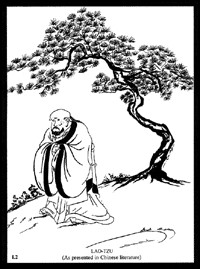
ALL CHINESE RELIGIONS are derived from the same ancient source of spiritual and religious experiences of the great Chinese sage prophet Fu Hsi. In the subsequent ages, many a great sage and thinker pondered over the works of Fu Hsi and studied them in-depth. Based on their study they presented to the Chinese people new philosophies, sciences, religions and moral teachings. Among them are King Wan, his son Cheu Kung and Lao-tzu, all held in great esteem by the Chinese people of all ages. The way of life presented by Lao-tzu (6th century BC), a contemporary of Confucius, is known as Taoism.

In Taoism, eternal truth is embodied in a being known as Tao whose attributes are spiritual and holy rather than material. Tao can be aptly defined as a personification of eternal virtues. They are precisely the same attributes as ascribed to God in Islam and other Divinely revealed religions. Taoism teaches man to completely submit to Truth (Tao), and to strive to modulate Tao. Tao is the model, and Taoism is the way to gain nearness to this model.

The same is the treatment in the Holy Quran regarding the relationship between God and man:

The hues of God! And who is more beautiful in hues than God?—and Him alone do we worship. 1

In Islam God is described and introduced through His attributes and the goal set for Muslims is to emulate them to modulate their lives. The description of Tao, presented by Lao-tzu, is quite similar to the attributes of God mentioned in the Quran. He writes:

'The great Tao is vast. He is on the left and He is on the right. All creatures depend upon Him, and the care of them tires Him not. He brings creation to completion, without seeking reward. He provides for all His creation, but requires nothing for Himself, so He may be considered small. All creatures turn to Him for their needs, yet He keeps nothing for Himself, thus He may be named 'the Supreme'. He does not consider Himself great and because of this He is truly Great.' 2

Again we have another description:

'Looked for but not visible, such a Being may be colourless. Listened for but not heard, such a Being may be called Silent. Grasped for but not caught, such may be called Concealed. No one can comprehend the ultimate source of these three qualities, but they are found in one Being. Though not luminous yet below Him there is no darkness. Being infinite He cannot be described. All His shapes keep returning to nothingness, thus we can say He is Shapeless; His image is without form. He is beyond comprehension (being the rarest of things). Try to reach His beginning, no beginning can be seen. Seek His end, no end can be perceived. Therefore, follow the ancient ways and improve your present.' 3

Also, in another verse the description of Tao runs as follows:

'He is indivisible and His true nature cannot be grasped. All creation originates from Him. He existed before heaven and earth were created. He is One and alone without form or sound. He exists independently without any support. Nothing changes in Him. He is in constant motion, but never tires. He can be called the Begetter of the universe.'4

The description of Tao given in the above passages is also found in different verses of the Quran, which when read together, reproduce everything covered by the above quotes. The image of God thus described in the Holy Quran, is summed up by the founder of the Ahmadiyya Muslim Community, the late Hazrat Mirza Ghulam Ahmadas of Qadian (India), in the following words:

'He is near yet far, distant yet close... He is highest of high, yet it cannot be said that there is anyone below Him farther than He. He is in heaven, but it cannot be said that He is not on Earth. He combines in Himself all the most perfect attributes and manifests the virtues which are truly worthy of praise.' 5

It is pertinent to note that Chinese philosophy had its roots in religion, but with the passage of time its religious origin was obscured. Its followers adhered to the philosophy itself but thought it unnecessary to have any direct link with the source which had nourished it in the past. Consequently, the image of God was gradually impersonalised and the followers of Tao ceased to cultivate a personal relationship with Him as a Supreme Conscious Living Being.

IN SHORT, like Confucianism, Taoism too at its source believed undoubtedly in a living, personal God to be the Eternal Truth. In the original works of Taoism or Confucianism, it was not considered sufficient just to gain an intellectual understanding of Tao, but the entire goal of life was set to mould one's character and actions according to the concept of Tao.

However, in the source material of Taoism, as quoted above, the belief in Tao as an eternal intelligent creator has over the ages been obscured. But the idea of revelation itself is still retained, though only under the guise of inspiration. A conspicuous shift from Divine revelation to inspiration without a Divine origin, marks the trend among the spiritual thinkers of the later ages until no trace of Divinity is left in their writings. Inspiration to them became purely an internal phenomenon, which through deep contemplation and meditation could lead to the fountainhead of truth within oneself.

To delve deep into one's nature can of course lead to the discovery of inner truth, but the Tao experience of inspiration as quoted in the authentic Taoist works is not entirely internal. With them inspiration has its own limitations—it cannot lead to objective truth which lies beyond the reach of the person who undergoes an inspirational experience.

The very foundation of Taoism is based on the great vision of Fu Hsi. The definition of inspiration however extended, can in no way be applied to that vision. When interpreted, it comprises such fountainheads of knowledge as were to give birth to many highly evolved and complex Chinese philosophies and sciences much later in time.

This is sufficient to illustrate the case in point. Inspirations cannot give birth to prophecies; no way can they lead to such future events as stand witness to the existence of an All-Knowing Supreme God by their realizations.


REFERENCES

  1. Translation of 2:139 by the author.
  2. DAN, L (1969) The Works of Lao Tzyy. Truth and Nature. The World Book Company, Ltd. Taipei, Taiwan, China. Ch.34, p.17
  3. DAN, L (1969) The Works of Lao Tzyy. Truth and Nature. The World Book Company, Ltd. Taipei, Taiwan, China. Ch.14, p.6
  4. DAN, L (1969) The Works of Lao Tzyy. Truth and Nature. The World Book Company, Ltd. Taipei, Taiwan, China. Ch.25, p.12
  5. Al-Wasiyyat. Roohani Khazain, 1984 edition, Vol.20, p.310
Revelation, Rationality, Knowledge & Truth

Wednesday, April 20, 2011

Marriage in Islam


The Review of Religions, November 1992

In the beginning I am presenting below the English translation of the Arabic sermon which is delivered on the occasion of the solemnization of a Muslim marriage:

All praise is due to God! We laud Him, we beseech help from Him and ask His forgiveness. We confide in Him; we trust in Him alone; and we seek protection with Allah against the evils and mischief of ourselves and from the vices of our deeds.

Whomsoever God guideth to the right path none can misguide him; and whomsoever He declares misled none can guide him unto the right path; and we bear witness that none is worthy of worship but God. He is alone and has no partner and we bear witness that Muhammad is His Servant and Apostle.

This is followed by the recitation of the following verses from the Holy Quran:

O ye people ! fear your Lord who created you from a single soul and of its kind created its mate, and from them twain spread many men and women; and fear ALLAH, in Whose name you appeal to one another, and fear him particularly respecting ties of kinship. Verily ALLAH watches over you (4:2)

O ye who believe ! Fear ALLAH and say the straightforward word.
HE will set right you actions for you and forgive you your sins. And whoso obeys ALLAH and HIS Messenger shall, surely, attain a supreme triumph
(33:71-72)

O ye who believe ! be mindful of your duty to ALLAH and let every soul look to what it sends forth for the morrow. And fear ALLAH, verily, ALLAH is Well-Aware of what you do. (59:19)

I would like to give an outline of marriage in Islam. First, however it is essential to know in what esteem woman is held in Islamic society and what rank she has been favoured with by Islam and by its Holy Founder Muhammad (peace and blessings of Allah be upon him).

To deal with this important subject I shall keep myself confined to the Holy Quran and the sayings of the Holy Prophet (peace and blessings of Allah be upon him), as interpreted by the Reformer of the age, Hazrat Mirza Ghulam Ahmad, the Founder of the Ahmadiyya Movement in Islam. It is indeed a matter of primary importance that eveyone who believes in any sacred scriptures as the revealed Word of God should not, in expounding the doctrines of that religion, go out of the Holy Book or depend upon arguments other than those which that book furnishes. Such a limitation would go far to simplify any dissertation upon a religion. It is the religion of Islam which confers such rights on women and not the society which has afterwards been evolved by it as is the case with other religions. Islam is unique in this respect by endowing a woman with equal rights and placing her on the same level as man. The Holy Quran says in this regard:

And ALLAH has made for you mates from among yourselves.... (16:73)

This verse shows that the Holy Quran has given the same status to men and women as it says that they are both from the same origin and due to this fact women should not be looked down upon men as lower creatures. Consequently they should not be dealt with harshly and roughly, rather men should deal with them in a very mild and soft manner. The Holy Prophet Muhammad (peace and blessings of Allah be upon him) has been reported to have said that women should be taken care of as some one takes care of glass products. Glass is liable to break very easily if it is not treated carefully. Men must follow therefore, be careful not to injure the delicacy of women because therein lies their beauty. The Holy Quran declares in another verse:

....And they (the women) have rights similar to those (of men) over them in equity; but men have a degree of advantage above them.... (2:229)

From this verse it can be easily deduced that as far as rights are concerned, women are equal with men but as the whole responsibility, according to Islam, of affording the household amenities rests with man therefore he has a rank above them in this respect.

The teachings of Islam make women eligible to inheritance and accordingly they receive their due share as prescribed by the Islamic law. A woman is entitled to individual ownership of property as a mother, as a wife, as a daughter, and as a sister. In the words of an American Justice Pierrs Craibites:

Muhammad 1300 years ago assured to the mothers, wives and daughters of Islam, the rank and dignity not yet generally assured to the women by the West

The Holy Prophet exalted the intellectual and spiritual status of women and said that the acquisition of knowledge is an incumbent duty to every Muslim male and female. The Holy Prophet of Islam knew the essential part women had to play in the development of society, so he laid great stress on the upbringing of girls by saying:

A man who has three daughters and brings them up and educates them to the best of his capacity shall be entitled to paradise

Regarding their spiritual status the Holy Quran says:

Whoso acts righteously, whether male or female and is a believer, WE will surely grant him a pure life; and WE will surely bestow on such their reward according to the best of their works (16:98)

In view of such ideal teachings concerning the fair sex how absurd is the assertion that according to Islam a woman has no soul.

Turning to marriage in Islam, it is first of all very important to know what is the real aim of marriage in Islam. If we understand it thoroughly, we would then certainly try to acheive it. The Holy Quran says:

And of HIS Signs is that HE has created wives for you from among yourselves that you may find peace of mind in them, and HE has put love and tenderness between you. In that, surely, are Signs for a people who reflect (30:22)

HE it is Who created you from a single soul and made therefrom its mate, that he might find comfort in her. (7:190)

These verses signify that marriage is meant for the attainment of peace of mind and mutual love and affection. Allah has also said that marriage is the means of attaining piety and of guarding one's chastity. He says:

....They are a sort of garment for you and you are a sort of garment for them.... (2:188)

The Arabic word `libas' (garment) means a thing which covers another thing. And according to the Holy Quran, a garment serves a threefold purpose: Allah says:

O children of Adam, WE have indeed send down to you raiment to cover you nakedness and to be a means of adornment... (7:27)

And then He says:

....HE has made for you garments which protect you from heat, and coats of mail which protect you in your wars.... (16:82)

Another use of our dress is that it provides protection against heat and cold. Since the Holy Quran has used the word 'garment' in respect of both the husband and wife, it proves beyond any shadow of doubt that they hold an equal status; their rights and duties are identical in respect of each other; and both are bound to fulfil their obligations to each other. When God declares each of them to be a garment for the other, He wishes it be known how they should discharge their duties towards each other which are as follows:

    1. To cover up one another's weaknesses and shortcomings from others.
    2. To act as an adornment and embellishment for one another.
    3. Just as clothes protect us from the severity and inclemency of the weather, so in the same way the wife and the husband should stick fast to each other through thick and at no time should they fall apart in adverse circumstances. Each should serve as a rock of support to the other.

According to the Islamic point of view, marriage is not an ordinary combination of two opposite sexes, nor is it only to quench one's sexual desires. It is rather holy reunion of two inevitable life companions on whose virtues or vices lies the prosperity or the disaster of human society. Marriage in Islam means laying the foundation of a fabric from which emerges a benevolent and beneficial society and therefore it enjoins upon every Muslim to marry. The first thing in this respect is that what the Holy Prophet Muhammad (peace and blessings of Allah be upon him) has said:

O company of the youth! he who can afford to marry should marry, for it keeps the eyes cast down and keeps the man chaste; and he who cannot afford to marry should take to fasting for it will have a sobering effect upon him.

According to this tradition it is quite clear that the purpose of marriage in Islam, as far as society is concerned, is to keep society chaste, healthy and pure from grossness and immorality. A man who can afford to marry and yet he refrains to marry must definitely be led to immorality and will be a nuisance to society which we today observe clearly as due to the so-called modern civilization. On the other hand when one is already married one would remain content and would not loiter about but would lead a pleasant family life.

The second thing that Islam says in this regard is that marriage has its lasting effects. Primarily it affects the lives of two persons and then comes the question of family and children. As long as the man is responsible for the maintenance of the family and children he will be forced to be away from the house for considerable periods of time and so the children would not be properly looked after and trained. The responsibility of their well-being and training has therefore been laid upon the woman by Islam. If the woman is chaste, pious, and religious, she would bring up the children in a well trained manner and thus the society emerging from these children would be highly moral and respectable. For this purpose the Holy Prophet of Islam said:

A woman is married for four things: (1) for her wealth; (2) for nobility of her family; (3) for her beauty and (4) for her (good) character, so attain success with one possessing good character.

It is evident from this tradition that Islamic marriage is based upon the betterment of the society and therefore the Holy Prophet of Islam left no stone unturned and let no opportunity go in this respect. Consequently he said: bring up the society pure, religious and straightforward the Holy Quran enjoins upon its followers that they should not marry idolaters because by doing so the purity of the worship of God would be adversely affected and the coming generations would become irreligious and estranged from God hence influencing their strength of character and poluting their religious feelings and leading them astrays. The Holy Quran says:

And marry not idolatrous women until they believe; even a believing bond women is better than an idolatress, although she may please you. And give not believing women in marriage to idolaters until they believe; even a believing slave is better than an idolater, although he may please you.... (2:222)

It is clear from this verse that Islam demands a purely religious and moral society in which there would be no godlessness and immorality. The main object of Islam is that purity and piety should be imbibed in the practice of Muslim to such an extent that their characters would become impeccable and faultless.

One of the greatest causes of immorality is secret relationship between men and women and then the grave consequences which cause confliction, collision, and ultimately separation. To nip the evil in its very bud, the Holy Prophet of Islam said:

No marriage is legal without the permission of the guardian.

This saying of the Holy Prophet shows that unless the would-be couple is known to the guardian (who is father and in his absence uncles and brothers respectively, or when all the legal guardians are absent, then the qazi (the judge) and unless the marriage tie is agreed upon by them the marriage is not valid.

In Islam when the agreement is reached and when all conditions of marriage are settled, then an announcement is to be made in the mosque or in court before a group of Muslims so that they may stand as witness that this marriage is legal and all its natural consequences are legimate.

The other reasons in the background of this announcement are that should there arise any dispute for which there is no solution except separation, or a child is born and the husband denies its legitimacy, or any other danger arises, then, if the announcement has not been made and both of them had relations secretly, there is the fullest possibility that the woman would be deprived of her legal rights. She can be denied the maintenance for her child; she can be deprived of her personal living or she can have her property given to her by her husband as there stands no witness to support her cause. To safeguard the rights of women, Islam makes its necessary to have the marriage tie announced before a group of people so that in case of such misunderstanding or crisis there would be witnesses and the woman could not be deprived of her rights.

It should be borne in mind that Islam does not allow a guardian to force his ward to accept his choice. The Holy Prophet of Islam is reported to have said:

The widow shall not be married until she is consulted and the virgin shall not be married until her consent is obtained.

Since man has been made responsible for providing sustenance for his wife and is her guardian and protector, it has been made compulsory for him to pay a dowry to his wife as a token of acknowledgement of her role which she has taken upon herself to play as wife. God says in the Holy Quran: And for the benefit you receive from them (women) give them their dowries. (4:25) There are cases, however, where husbands grudge this payment. Allah commands that the dowry must be paid cheerfully and with good grace. God says:

And give the women their dowries willingly. But if they, of their own pleasure, remit to you a part thereof, then enjoy it as something pleasant and wholesome.... (4:5)

There is a tendency of fixing large dowries which in many cases leads to misunderstandings and friction between the two familites and ultimately to the dissolution of the marriage. Islam looks with disfavour upon fixing large dowries except in exceptional circumstances where it cannot be helped, i.e. the necessity to safeguard the bride's right of inheritance. The Holy Prophet of Islam has said:

Blessed is the marriage which comes about with ease and entails no hardship, it must not entail too heavy a burden of expenses nor should the dowry be too much for the bridgegroom to pay.

As a matter of fact the amount of dowry should be fixed according to the financial standing of the bridegroom and with the consent of both parties. Hazrat Mirza Bashiruddin Mahmood Ahmad, the second sucessor to the Promised Messiah, was of the opinion that the sum proposed for dowry should range between the bridegroom's income for six to twelve months. He once said:

Those who fix large dowries, only for show and fail to pay, are guilty of committing a sin. The companions of the Holy Prophet used to pay the dowry money in advance. Hence, the best thing is to pay it up in advance, if possible. Dowry is, in fact, a debt owed by the husband to his wife. (Alfazl 15-1-1918)

I will now proceed to explain the rightful duties of the wife:
    1. She has to look after the comfort of her husband, give him due respect and always have regard for his feelings.
    2. She has to safeguard the honour of her husband.
    3. She has to be the guardian of the property of her husband.
    4. She has to rear and bring up their children properly.
    5. She should treat the relatives of her husband as if they were her own relatives.
    6. She should beautify herself for her husband.
    7. She should bear in mind the tastes of her husband in the matter of food and dress.
    8. She should be ever mindful of her husband's health.
    9. She should give her most sincere advice when her husband consults her in any of his problems.
    10. She should not make unfair and unreasonable demands on the purse of her husband.
    11. She has to remain loyal to her husband under all conditions and be a source of strength to him in adverse circumstances and stick fast to him through thick and thin.
    12. She should be careful that the dignity and reputation of her husband are not harmed by any of her actions.
    13. Under all conditions her behaviour should be conducive to peace and tranquility in the house.

The rightful duties of the husband are:

    1. He should respect and be very mindful of the susceptibilities of his wife.
    2. He should try to be a source of comfort to his wife and behave in a manner that convinces her that she alone is the centre of his love and affection.
    3. He should provide for all her reasonable needs and keeping within his means and should be disposed to spending in that respect with an open hand.
    4. The husband should participate in the management of the house by giving hand in the household chores of his spouse.
    5. He should look after her health and be always anxious about it.
    6. He should refrain from keeping a close watch over every movement of his wife as if he had no confidence in her and thus making her life miserable.
    7. He should always be disposed to overlooking the minor shortcomings of his wife and be generous in forgiving and forgeting.
    8. He should see that trifles do not lead to a situation in which tempers are lost and threats of divorce and separation are pronounced.
    9. He should shun every act or act which is likely to displease or agonise his wife.
    10. The husband should display a sense of utmost sympathy towards his wife when she is in distress or has met with some misfortune.
    11. He should not object to his wife meeting her relatives provided no mischief is feared from their side. He should also be respectful to them.
    12. He should consult his wife in all family matters of importance and handle the situation as decided by mutual consent.
    13. If there are more wives than one, the husband must treat them all as equal in every respect, in dress, in food, in living accomodation and in the duration of his stay with each of them.

I am confident that the new couple in particular and other Muslim brethren in general will try their utmost to maintain the rights of their spouses as directed by the Holy Quran and the Holy Prophet of Islam, thus making their lives happy and successful.

Finally, I would like to advise new wedded couple to repeat often the following prayer in the Holy Quran:

And those who say, `Our Lord, grant us of our wives and children the delight of our eyes, and make us a model for the righteous.' (25:75)


Ata Ullah Kaleem


Thursday, April 14, 2011


Ahmadiyya Muslim Community


Ahmadiyya Muslim Community is the foremost Islamic organization with a central spiritual leader. Over a century ago, Ahmad(as) reminded his followers of God’s promise to safeguard the message of Islam through khilafat (the spiritual institution of successorship to prophethood). It believes that only spiritual successorship can uphold the true values of Islam and unite humanity. Five spiritual leaders have succeeded Ahmad(as) since his demise in 1908. It’s fifth and current spiritual head, Mirza Masroor Ahmad, resides in the United Kingdom. Under the leadership of its spiritual successors, Ahmadiyya Muslim Community has now built over 15,000 mosques, over 500 schools, and over 30 hospitals. It has translated the Holy Quran into over 60 languages. It propagates the true teachings of Islam and the message of peace and tolerance through a twenty-four hour satellite television channel (MTA), the Internet (alislam.org) and print (Islam International Publications). It has been at the forefront of worldwide disaster relief through an independent charitable organization, Humanity First.Ahmadiyya Muslim Community is the foremost Islamic organization with a central spiritual leader. Over a century ago, Ahmad(as) reminded his followers of God’s promise to safeguard the message of Islam through khilafat (the spiritual institution of successorship to prophethood). It believes that only spiritual successorship can uphold the true values of Islam and unite humanity. Five spiritual leaders have succeeded Ahmad(as) since his demise in 1908. It’s fifth and current spiritual head, Mirza Masroor Ahmad, resides in the United Kingdom. Under the leadership of its spiritual successors, Ahmadiyya Muslim Community has now built over 15,000 mosques, over 500 schools, and over 30 hospitals. It has translated the Holy Quran into over 60 languages. It propagates the true teachings of Islam and the message of peace and tolerance through a twenty-four hour satellite television channel (MTA), the Internet (alislam.org) and print (Islam International Publications). It has been at the forefront of worldwide disaster relief through an independent charitable organization, Humanity First.

Tuesday, April 12, 2011


Unity is Strength

Unity is strength! The fundamental message of Islam is the Unity of God and the establishment of the unity of mankind bound together by ties of practical brotherhood. This is the clarion call of Islam which abhors strife, hatred, greed, selfishness, pride, intolerance and such like unbrotherly dispositions. The aim of every Muslim should be in accordance with the injunction of the Holy Quran:

Help one another in righteousness and piety.


The Holy Prophet of Islam has likened the true spirit of Islamic brotherhood to that of a building every part of which reinforces other parts and, as an undivided symbol of unity, commanded Muslims when lined up for prayer to stand together shoulder to shoulder like a solid wall leaving no space for even a rod to be passed between them.
Islam is a universal religion revealed by God for the guidance of all mankind and is above personal bias, tribal prejudice and ignorant sectarianism. It teaches that all human beings are equal and nobody is superior to another due to origin, colour, genealogy or race. The only difference in the sight of God between individuals is their degree of righteousness. As God says in the Holy Quran:

Verily the most honourable person among you in the sight of God is he who is the most righteous among you.
(49:14)

This ideal of Islamic unity and brotherhood which is sadly lacking in the world today can only be achieved by devoutedly acting upon the injunctions of Islam. Muslims should act upon and call people to what is good, and avoid and forbid what is bad. The strong and more fortunate should help the weak and less fortunate. The rich should help the poor. No one should usurp the property and rights of others. Religious tolerance is essential.

Editorial
Review of Religions, July 1993